Powys County Archives
The Master reported that the stones had been removed off the road and that all stones were now being properly broken by the vagrants."
Social Conditions
Conditions in Llanfyllin Workhouse
Workhouses continued to be grim, forbidding places in 1891, although conditions had improved from earlier in the century. They had been deliberately built to resemble prisons, with strict, harsh rules, strict segregation of men, women and children, meagre rations and grinding, relentless work. The idea behind this was to encourage people to strive to help themselves, as the consequences of failing to do so would mean admission to the workhouse.
An entry from the Llanfyllin minute book on 5th March 1891 shows that vagrants were still being set to work breaking stones for roadmaking:
Powys County Archives |
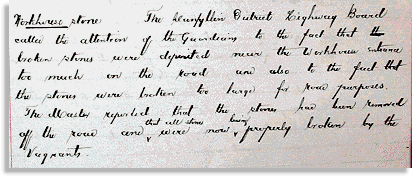
"Workhouse Stone The Llanfyllin District
Highway Board called the attention of the Guardians to the fact that broken
stones were deposited near the workhouse entrance too much on the road and
also to the fact that the stones were broken too large for road purposes. The Master reported that the stones had been removed off the road and that all stones were now being properly broken by the vagrants." |
This was a useful source of income for the Union:
 Powys County Archives |
"The Master reported that he had sold to the County surveyor 50 tons of broken stone at 2s/9d per ton." |
Another common task performed by both men and women was that of picking oakum. This was the fibre created by picking old rope to pieces. It was used for caulking (stopping up seams in ships), and as a waterproofing material. Additionally, all inmates other than the very young or infirm were required to help out with tasks necessary to run the workhouse.
The master at Forden Workhouse was the subject of a complaint from one of the paupers because of a punishment he had administered:
 Powys County Archives |
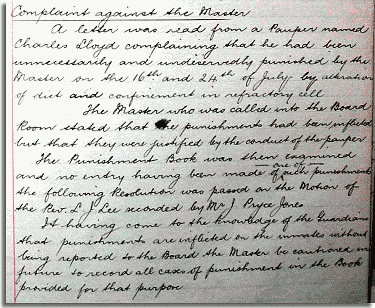
"Complaint against
the Master The Master who was called into the Board Room stated that the punishment had been inflicted but that they were justified by he conduct of the pauper. The Punishment Book was then examined and no entry having been made of one of such punishments the following Resolution was passed on the motion of the Rev L J Lee seconded by Mr Pryce Jones. It having come to the knowledge of the Guardians that punishments are inflicted on the inmates without being reported to the Board the Master be cautioned in future to record all cases of punishment in the Book provided for that purpose." |
However, all was not work and misery for the inmates at Llanfyllin, as some
efforts were being made to improve their lot. The post-Christmas meeting reported: