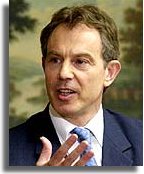
Prime Minister Tony Blair
Civic and Community
Tony Blair's statement to Parliament on Iraq
This was the statement given by UK Prime Minster Tony Blair to Parliament on the threat posed by Iraq and its weapons on mass destruction. Tuesday September 24, 2002.
Prime Minister Tony Blair
"Mr Speaker, thank you for recalling Parliament to debate the best way to deal with the issue of the present leadership of Iraq and weapons of mass destruction.
Today we published a 50-page dossier detailing the history of Iraq's WMD, its breach of UN resolutions and the current attempts to rebuild the illegal WMD programme. I have placed a copy in the Library of the House.
At the end of the Gulf War, the full extent of Saddam's chemical, biological and nuclear weapons programmes became clear. As a result, the UN passed a series of resolutions demanding Iraq disarm itself of such weapons and establishing a regime of weapons inspection and monitoring to do the task. They were to be given unconditional and unrestricted access to all and any Iraqi sites.
All this is accepted fact. In addition, it is fact, documented by UN inspectors, that Iraq almost immediately began to obstruct the inspections. Visits were delayed; on occasions, inspectors threatened; material was moved; special sites, shut to the inspectors, were unilaterally designated by Iraq.
The work of the inspectors continued but against a background of increasing obstruction and non-compliance. Indeed, Iraq denied its biological weapons programme existed until forced to acknowledge it after high ranking defectors disclosed it in 1995.
Eventually in 1997, the UN inspectors declared they were unable to fulfil their task. A year of negotiation and further obstruction occurred until finally in late 1998, the UN team were forced to withdraw. As the dossier sets out, we estimate on the basis of the UN's work that there were: up to 360 tonnes of bulk chemical warfare agents, including one and a half tonnes of VX nerve agent; up to 3,000 tonnes of precursor chemicals; growth media sufficient to produce 26,000 litres of anthrax spores; and over 30,000 special munitions for delivery of chemical and biological agents.
All of this was missing or unaccounted for.
Military action by the US and UK followed and a certain amount of infrastructure for Iraq's WMD and missile capability was destroyed, setting the Iraqi programme back, but not ending it.
From late 1998 onwards, the sole inhibition on Saddam's WMD programme was the sanctions regime. Iraq was forbidden to use the revenue from its oil except for certain specified non-military purposes. The sanctions regime, however, was also subject to illegal trading and abuse. Because of concerns about its inadequacy - and the impact on the Iraqi people - we made several attempts to refine it, culminating in a new UN resolution in May of this year. But it was only partially effective. Around $3bn of money is illegally taken by Saddam every year now, double the figure for 2000. Self-evidently there is no proper accounting for this money.
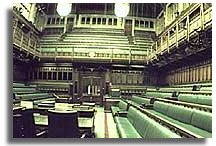
The House of Commons, WestminsterBecause of concerns that a containment policy based on sanctions alone could not sufficiently inhibit Saddam's weapons programme, negotiations continued after 1998 to gain re-admission for the UN inspectors. In 1999 a new UN resolution demanding their re-entry was passed and ignored. Further negotiations continued. Finally, after several months of discussion with Saddam's regime this year, Kofi Annan, the UN Secretary General, concluded that Saddam was not serious about re-admitting the inspectors and ended the negotiations. That was in July.
All of this is established fact. I set out the history in some detail because occasionally debate on this issue seems to treat it almost as if it had suddenly arisen, coming out of nowhere on a whim, in the last few months of 2002. It is an 11 year history: a history of UN will flouted, lies told by Saddam about existence of his chemical, biological and nuclear weapons programmes, obstruction, defiance and denial. There is one common consistent theme, however: the total determination of Saddam to maintain the programme; to risk war, international ostracism, sanctions, the isolation of the Iraqi economy, in order to keep it. At any time, he could have let the inspectors back in and put the world to proof. At any time he could have co-operated with the UN. Ten days ago he made the offer unconditionally, under threat of war. He could have done it at any time in the last eleven years. But he didn't. Why?
The dossier we publish gives the answer. The reason is because his chemical, biological and nuclear weapons programme is not an historic leftover from 1998. The inspectors aren't needed to clean up the old remains. His WMD programme is active, detailed and growing. The policy of containment is not working. The WMD programme is not shut down. It is up and running. The dossier is based on the work of the British Joint Intelligence Committee. For over 60 years, beginning just prior to WWII, the JIC has provided intelligence assessments to British Prime Ministers. Normally its work is secret. Unusually, because it is important we explain our concerns over Saddam to the British people, we have decided to disclose these assessments. I am aware, of course, that people are going to have to take elements of this on the good faith of our intelligence services. But this is what they are telling me the British Prime Minister and my senior colleagues. The intelligence picture they paint is one accumulated over the past four years. It is extensive, detailed and authoritative.
It concludes that Iraq has chemical and biological weapons, that Saddam has continued to produce them, that he has existing and active military plans for the use of chemical and biological weapons, which could be activated within 45 minutes, including against his own Shia population; and that he is actively trying to acquire nuclear weapons capability.
On chemical weapons, the dossier shows that Iraq continues to produce chemical agent for chemical weapons; has rebuilt previously destroyed production plants across Iraq; has bought dual-use chemical facilities; has retained the key personnel formerly engaged in the chemical weapons programme; and has a serious ongoing research programme into weapons production, all of it well funded.
In respect of biological weapons, again production of biological agents has continued; facilities formerly used for biological weapons have been rebuilt; equipment has been purchased for such a programme; and again Saddam has retained the personnel who worked on it, pre 1991. In particular, the UN inspection regime discovered that Iraq was trying to acquire mobile biological weapons facilities which are easier to conceal. Present intelligence confirms they have now got such facilities. The biological agents we believe Iraq can produce include anthrax, botulinum, toxin, aflatoxin and ricin. All eventually result in excruciatingly painful death.
As for nuclear weapons, Saddam's previous nuclear weapons programme was shut down by the inspectors, following disclosure by defectors of the full, but hidden, nature of it. That programme was based on gas centrifuge uranium enrichment. The known remaining stocks of uranium are now held under supervision by the International Atomic Energy Agency.
But we now know the following. Since the departure of the inspectors in 1998, Saddam has bought or attempted to buy: specialised vacuum pumps of the design needed for the gas centrifuge cascade to enrich uranium; an entire magnet production line of the specification for use in the motors and top bearings of gas centrifuges; dual use products such as Anhydrous Hydrogen Fluoride and fluoride gas, which can be used both in petrochemicals but also in gas centrifuge cascades; a filament winding machine, which can be used to manufacture carbon fibre gas centrifuge rotors; and has attempted, covertly, to acquire 60,000 or more specialised aluminium tubes, which are subject to strict controls due to their potential use in the construction of gas centrifuges.
In addition, we know Saddam has been trying to buy significant quantities of uranium from Africa, though we do not know whether he has been successful. Again key personnel who used to work on the nuclear weapons programme are back in harness. Iraq may claim that this is for a civil nuclear power programme but it has no nuclear power plants.
That is the position in respect of weapons. But, of course, the weapons require ballistic missile capability. This is again subject to UN disarmament resolutions. Iraq is supposed only to have missile capability up to 150 km for conventional weaponry. Pages 27-31 of the dossier detail the evidence on this issue. It is clear both that a significant number of longer-range missiles were effectively concealed from the previous inspectors and remain, including up to 20 extended range Scud missiles; that in mid 2001, there was a step change in the programme and by this year, Iraq's development of weapons with a range over 1,000km was well underway; that hundreds of key people are employed on this programme; facilities are being built; and equipment procured, usually clandestinely. Sanctions and import controls have hindered this programme but only slowed its progress. The capability being developed is for multi-purpose use, including with WMD warheads.
Now, that is the assessment to me from the JIC. In addition, we have well-founded intelligence to tell us that Saddam sees his WMD programme as vital to his survival, as a demonstration of his power and his influence in the region.
There will be some who dismiss all this. Intelligence is not always right. For some of this material there may be innocent explanations.
There will be others who say, rightly, that, for example, on present going, it could be several years before he acquires a usable nuclear weapon. Though, if he were able to purchase fissile materiel illegally, it would only be a year or two.
But let me put it at its simplest: on this 11 year history; with this man, Saddam; with this accumulated, detailed intelligence available; with what we know and what we can reasonably speculate: would the world be wise to leave the present situation undisturbed; to say, despite 14 separate UN demands on this issue, all of which Saddam is in breach of, we should do nothing; to conclude that we should trust not to the good faith of the UN weapons inspectors but to the good faith of the current Iraqi regime?
Our case is simply this: not that we take military action, come what may; but that the case for ensuring Iraqi disarmament (as the UN has stipulated) is overwhelming. I defy anyone on the basis of this evidence to say that is an unreasonable demand for the international community to make when, after all, it is only the same demand that we have made for 11 years and he has rejected.
People say: but why Saddam? I don't in the least dispute there are other causes of concern on WMD. I said as much in this House on 14 September last year. But two things about Saddam stand out. He has used these weapons, thousands dying in chemical weapons attacks in Iraq itself. He used them in the Iran-Iraq war, started by him, in which one million people died. And his is a regime with no moderate elements to appeal to. Read the chapter on Saddam and human rights. Read not just about the one million dead in the war with Iran, not just about the 100,000 Kurds brutally murdered in northern Iraq; not just the 200,000 Shia Muslims driven from the marshlands in southern Iraq; not just the attempt to subjugate and brutalise the Kuwaitis in 1990 which led to the Gulf War. Read about the routine butchering of political opponents; the prison "cleansing" regimes in which thousands die; the torture chambers and hideous penalties supervised by him and his family and detailed by Amnesty International. Read it all and again I defy anyone to say that this cruel and sadistic dictator should be allowed any possibility of getting his hands on more chemical, biological or even nuclear weapons.
Why now? People ask. I agree I cannot say that this month or next, even this year or next, that he will use his weapons. But I can say that if the international community having made the call for his disarmament, now, at this moment, at the point of decision, shrugs its shoulders and walks away, he will draw the conclusion dictators faced with a weakening will, always draw. That the international community will talk but not act; will use diplomacy but not force; and we know, again from our history, that diplomacy, not backed by the threat of force, has never worked with dictators and never will work. If we take this course, he will carry on, his efforts will intensify, his confidence grow and at some point, in a future not too distant, the threat will turn into reality. The threat therefore is not imagined. The history of Saddam and WMD is not American or British propaganda. The history and the present threat are real.
And if people say: why should Britain care? I answer: because there is no way that this man, in this region above all regions, could begin a conflict using such weapons and the consequences not engulf the whole world.
That, after all, is the reason the UN passed its resolutions. That is why it is right the UN Security Council again makes its will and its unity clear and lays down a strong new UN resolution and mandate. Then Saddam will have the choice: comply willingly or be forced to comply. That is why alongside the diplomacy, there must be genuine preparedness and planning to take action if diplomacy fails.Let me be plain about our purpose.
Of course there is no doubt that Iraq, the region and the whole world would be better off without Saddam. They deserve to be led by someone who can abide by international law, not a murderous dictator.
Someone who can bring Iraq back into the international community where it belongs, not languishing as a pariah.
Someone who can make the country rich and successful, not impoverished by Saddam's personal greed.
Someone who can lead a government more representative of the country as a whole, while maintaining absolutely Iraq's territorial integrity.We have no quarrel with the Iraqi people. Liberated from Saddam, they could make Iraq prosperous and a force for good in the Middle East.
So the ending of regime would be the cause of regret for no-one other than Saddam.
But our purpose is disarmament. No-one wants military conflict. The whole purpose of putting this before the UN is to demonstrate the united determination of the international community to resolve this in the way it should have been resolved years ago: through a proper process of disarmament under the UN.
Disarmament of all WMD is the demand. One way or another it must be acceded to.
There are two other issues with a bearing on this question which I will deal with.
First, Afghanistan is a country now freed from the Taliban, but still suffering. This is a regime we changed, rightly. I want to make it clear, once again, we are entirely committed to its re-construction. We will not desert the Afghan people. We will stick with them until the job is done.Secondly, I have no doubt the Arab world knows it would be better off without Saddam. Equally, I know there is genuine resentment at the state of the Middle East Peace Process, which people want to see the international community pursue with the same vigour. Israel will defend its people against these savage acts of terrorism. But the very purpose of this terrorism is to prevent any chance for peace. Meanwhile the Palestinians are suffering in the most appalling and unacceptable way. We need urgent action to build a security infrastructure that gives both Israelis and Palestinians confidence and stops the next suicide bomb closing down the prospects of progress. We need political reform for the Palestinian Authority. And we need a new Conference on the Middle East Peace Process based on the twin principles of a secure Israel and a viable Palestinian state. We can condemn the terrorism and the reaction to it. But frankly, that gets us nowhere. What we need is a firm commitment to action and a massive mobilisation of energy to get the peace process moving again; and we will play our part in any way we can.
Finally, there are many acts of this drama still to be played out. I have always said that Parliament should be kept in touch with all developments, in particular those that would lead us to military action. That remains the case. To those who doubt it, I say: look at Kosovo and Afghanistan. We proceeded with care, with full debate in this House and when we took military action, did so as a last resort. We shall act in the same way now. But I hope we can do so, secure in the knowledge that should Saddam continue to defy the will of the international community, this House, as it has in our history so many times before, will not shrink from doing what is necessary and right. "