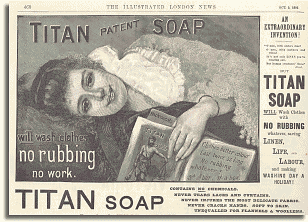
Titan soap advert from
Heywood's Guide to Llandrindod Wells
Powys County Archives
Home Life
Washing Day
Titan soap advert from
Heywood's Guide to Llandrindod Wells
Powys County Archives
Washing day was a major event in the Victorian household. Due to the labour involved, it was also infrequent, occurring perhaps once a month to be more economically viable. The less frequent the washing, the more affluent a family could claim to be, as they would have sufficient clothing to wear until next wash day.
Large country houses would have a purpose-built laundry, an idea which was copied by larger homes and farmhouses. Smaller homes had to content themselves with using the kitchen or the yard for the purpose. Before indoor plumbing, water often had to be carried some distance. Efforts were made to store rainwater, and rural communities could still use streams for washing.
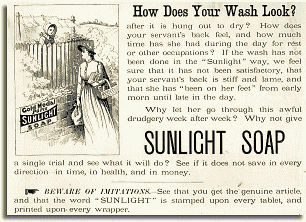
The use of soap for washing increased throughout the second half of the nineteenth century after the tax on it was abolished in 1853. Over a stone (16lbs) of soap per person was being used by 1891. In addition, sometimes bleaches and 'blue' were used for white clothes. Starch was used for linens, aprons and collars and this was often regarded as a specialist skill.
Washing was done in tubs or bucks. These were usually wooden, although metal ones were becoming more common. The actual washing was done with a 'dolly' - a pole with one end shaped either like a cone or a small three-legged stool. This was used to plunge and agitate the clothes in the boiling water. Washboards were becoming more popular, used with a wider, bath shaped tub; these were easier and quicker to use than the old dollies. Clothes would be rubbed with soap to remove stains. Washing machines, although in existence in 1891, were not generally popular and were expensive to buy and run.
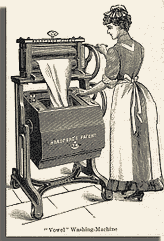
'Vowel' washing machine, from
The Art and Practice of Laundry Work,
M C Rankin, Blackie & Son, London, c1912.
This particular machine cost £3.
Collection of Margaret Reid
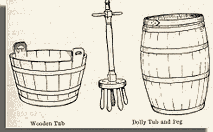
Dolly tub and peg,
from M C Rankin, op.cit.
Collection of Margaret Reid
The process of washing lasted for most of the day and had to be started early in order to get it all dried. It was still quite usual to dry washing on hedges or even on mown fields, or on clothes horses and lines in the house in wet weather.
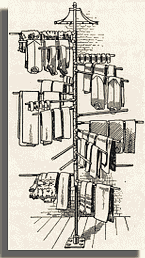
Drying rail, from
M CRankin, op. cit.
Collection of Margaret Reid
When the items were fully washed and rinsed, they would be wrung to remove excess water, and hung to dry. Once dry or nearly dry, clothes and bedding would be mangled to smoothe them, sometimes taking the place of ironing. Mangles might also be used for wringing clothes. Mangles were widely owned as they became smaller and more affordable.
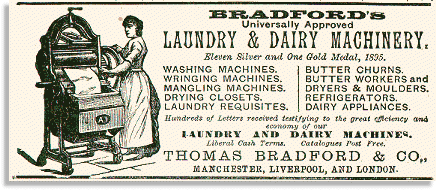
Advert for Bradford's Universally Approved Laundry
& Dairy Machinery,
from Heywood's Guide to Llandrindod Wells
Powys County Archives
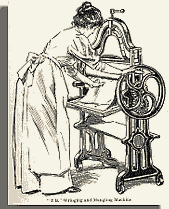
'T.B.' Wringing and Mangling
Machine, from M C Rankin, op.cit.
Collection of Margaret Reid
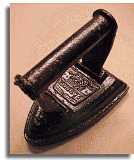
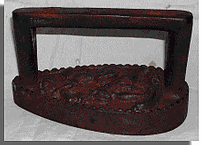
Finally the items would be ironed. Flat irons were of various weights but did not keep their heat for long periods. Irons came in various types and sizes, for different fuels and ironing tasks.
|
|
|
The clothes would then be left to air.
As washing was such an arduous process, it provided a cottage industry for women who were prepared to undertake the work for a fee.